
Date of Publication
June 13, 2026
Category
News
Resources
Repost This Article
.svg)
.svg)
.svg)
.svg)
We roof a handful of jobs every year where the only way your shingles, metal, and fasteners get to site is on a barge, and the only way your crew gets to work is on the ferry or a water taxi. Island sites on the Sunshine Coast. Historic churches north of the Strait. Waterfront homes at Bliss Landing, north of Powell River, where road access does not exist. These jobs run on a different timeline than suburban reroof work, and the planning starts long before any materials leave a supplier.
The logistics are what separate a barge job from regular contracting. You cannot order materials three days before you start. You cannot run out mid-job and grab the flashing you forgot. Winter storms close the water for extended stretches. A missed window in summer or early fall can mean waiting until the following season to complete the job. But the work itself, and the sites, are often the most satisfying we do.
Every pound counts when you are shipping by water. We stage materials well in advance and coordinate delivery to match the access window available at each site. For the Alert Bay church, that meant bringing in the roof membrane, custom sheet-metal cladding fabricated in our own shop, fasteners, flashings, and underlayment in a single coordinated load. We finish all ordering and double-check quantities before the barge booking is confirmed. There is no room for the shortcuts that work on the mainland.
The Jeffrey Rubinoff Sculpture Park on Hornby Island and the Bliss Landing residence were similar exercises. You think through every material, every tool, every consumable before the vessel leaves port. If something is missing when you arrive, it stays missing for days at minimum.
Coastal exposure shapes material choices too. Salt spray accelerates corrosion on exposed sites, so fastener and flashing specs get tightened for waterfront work. Wind loading on island sites like Hornby can be significant, and those details get locked in at the estimate stage rather than adjusted on the fly.
The water does not care about your schedule. A barge site is only practical during certain months. Summer is safer for vessel traffic, but you are competing with everyone else who needs water access. Fall can work if you book early, but you are watching the forecast every day. One serious windstorm or sustained swell, and your crew is off the island.
We build those realities into the estimate and the timeline from the start. A job that would move quickly on a mainland site may stretch across multiple weather windows at a remote location. That is not a problem if it is accounted for upfront. It becomes a problem if it is not.
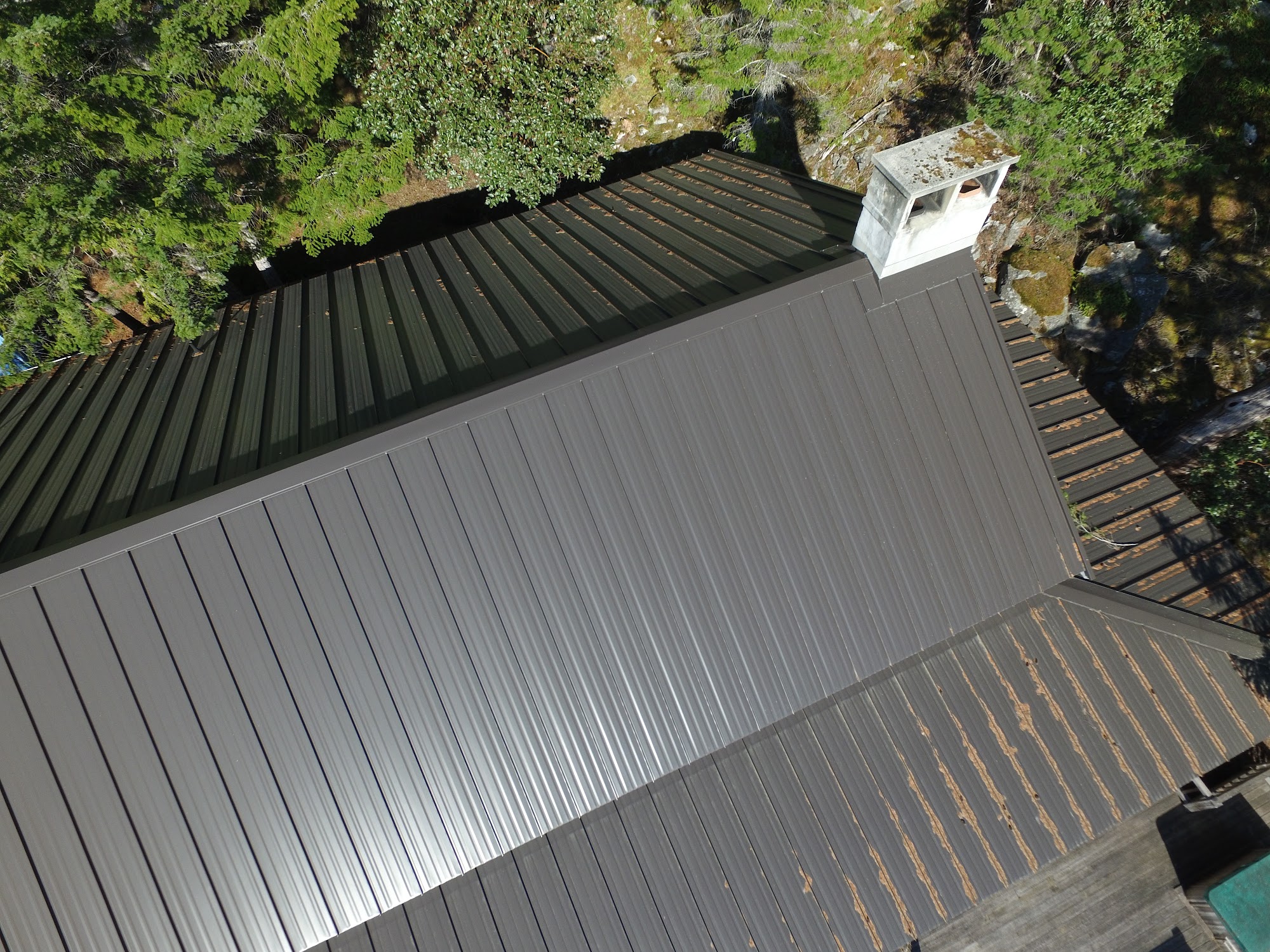
Not every roofer wants to spend a week on an island or commute by ferry. The people we send to Hornby or Alert Bay are comfortable with the isolation, flexible when conditions shift, and disciplined enough to show up early because the ferry schedule does not bend for you. We have built a crew that is suited to this kind of work. The pace is steadier, the sites are genuinely interesting, and finishing a roof on a small island has its own satisfaction.
Water-access sites also require stricter site management. Everything is tied down and accounted for. Fall-protection standards are enforced in full. We coordinate with the property owner or facility manager on access routes and staging areas, which are often tight or unconventional by mainland standards.
Barge jobs force you to think like a project manager before you think like a roofer. The scope is the same as any other job: sound membrane, proper flashings, metal trim specified for the coastal climate. But the path to get there is longer and less forgiving. We have learned to treat that planning as part of the work, not overhead. You cannot underestimate the logistics and expect the roof to go in cleanly when you are this far from a supply house.
If you have a waterfront property on the BC coast or a remote island site that needs roofing attention, start the conversation early. Some jobs are better phased across seasons depending on site access. Others make more sense to tackle in a single push if you can book the barge window in advance. Call us at 250-336-8088 and we can work through the access logistics with you before anything else.
.svg)
.svg)
Our new website is live, bringing the full project portfolio, all eight service lines and our three service areas into one place.
A real estimate tells you exactly what you're paying for. Here's what separates an honest bid from a vague one.
The real tradeoffs between flat and pitched roofs for commercial buildings on Vancouver Island.
A practical checklist for Vancouver Island homeowners to prepare their roofs for heavy rain and wind before winter storms arrive.
Nelson Roofing shares real work on two First Nations projects: I-Hos Gallery and Discovery Harbour Shopping Centre.
Why exposed structural wood raises the stakes on weather protection and how to get moisture detailing right on Vancouver Island.
Why Nelson Roofing runs its own sheet metal fabrication shop, and what that means for fit, colour, and lead time on Vancouver Island projects.
How institutional scheduling works and why Campbell River schools plan roofing work around school holidays.
A guide to phased and after-hours roof replacement for BC businesses that cannot afford downtime.
Moss growth on shaded Island roofs damages shingles and drainage. Learn why it thrives on the coast and how to remove it safely.
Immediate steps to take when your roof leaks, what contractors need to know, and why quick patches often fail.
A practical guide to vetting roofing contractors: RCABC credentials, local references, written estimates, safety records, and who shows up to do the work.
A guide to TPO roofing for low-slope commercial and residential buildings on Vancouver Island, covering installation, maintenance, and real-world durability.
Standing seam metal roofing handles coastal weather better than most materials -- salt spray, wind, and heavy rain do not break it.
Island and water-access roofing requires planning materials, coordinating barge deliveries, and working within weather windows on the remote BC coast.
How Nelson Roofing replaced 50,175 sq ft of membrane on a heritage 1930 arena while keeping games and events on schedule.
Institutional roofing on Vancouver Island requires infection control, strict phasing, and mechanical integration that standard commercial projects rarely face.
Nelson Roofing completed 776,700 sq ft of roofing across two major hospital builds on Vancouver Island, the largest contract in company history.
How Nelson Roofing delivered the cladding and custom sheet-metal package on two mass timber buildings holding 217 beds in Courtenay.
Real press coverage of Nelson Roofing's major island projects and what RCABC accreditation means for building owners.
The VIU Shellfish Research Centre in Deep Bay won the 2011 Metalmag Architectural Award (Roofing Category) for its curved radius seam metal roof.
How Nelson Roofing manages multi-family roofing projects on Vancouver Island with noise control, resident safety, and marine-grade detailing.
Campbell River dealerships like Strathcona Toyota need roofs that protect inventory while staying quiet during business hours.
How Nelson Roofing re-roofed Wembley Liquor Store in Parksville before and after hours while the store stayed open for customers.
Nelson Roofing brings the same exacting standards to Powell River and the Sunshine Coast as we do on Vancouver Island -- logistics are different, but quality never wavers.
Why HVAC and roofing decisions must be coordinated from the design phase, not bolted together after the fact.
Nelson Roofing installed standing seam metal roofing on the Comox Marina Park pavilion, engineered for coastal salt spray and wind exposure.
Compare metal, shingle, and low-slope roofing options for Vancouver Island coastal homes dealing with rain, wind, and salt exposure.
What commercial property owners should know about roofing systems, membranes, and phased installations around tenant operations on Vancouver Island.
A practical fall checklist for Vancouver Island homeowners to prepare coastal roofs for winter weather.
A plain walkthrough of a commercial or residential roof replacement, from inspection and tear-off to final cleanup and warranty.
Nelson Roofing handles roofing, sheet metal fabrication, and HVAC across Vancouver Island - from student housing to hospitals and historic landmarks.
We were named Subcontractor of the Year at the 2026 VICA Awards for our cladding work on the North Island College student housing project.
We were named 2025 RCABC Guarantee Corp Top Supporter for completing the most roofing squares on Vancouver Island last year.
Nelson Roofing marked 45 years in 2025, from Russ and Sharon Nelson's first crews in 1980 to three branches on the coast today.
The RCABC magazine Roofing BC profiled the company in its Summer 2014 issue, covering our change of ownership and four recent projects.
Canadian Roofing Contractor and Design profiled our work on the Deep Bay shellfish research field station in its January/February 2012 issue.
.svg)
.svg)
.svg)
.svg)

.svg)
.svg)