
Date of Publication
June 13, 2026
Category
Resources
Featured
Repost This Article
.svg)
.svg)
.svg)
.svg)
If you are weighing a standing seam metal roof for a Vancouver Island property, the coastal argument for it is practical. On the Wolfgang Residence, it sheds rain off the slope before it pools. Concealed fasteners mean nothing corrodes where water collects. That is the difference between a roof that holds up and one that needs constant repair in a coastal climate.
Vancouver Island sits in a weather corridor: heavy winter rain, salt air from the Pacific, wind gusts that bend gutters. Most roofs handle rain. Standing seam handles rain, salt spray, and wind all at once without the exposed fasteners that let corrosion work its way in.
In a traditional roof, fasteners sit exposed to weather. Rain finds them, salt corrodes them, then water seeps through. Even stainless fasteners get stressed over time. Standing seam panels overlap and lock together. The fasteners hide underneath, fully protected from spray and runoff.
The panels themselves expand and contract as temperature swings. The standing seam joint flexes with that movement instead of fighting it. Metal roofs on older homes around the island often outlast their structures because they adapt to coastal conditions instead of resisting them.
Standing seam costs more upfront than asphalt or some composite materials. But on coastal properties where salt and wind accelerate decay, the math shifts fast.
Consider maintenance: asphalt roofs get moss growth in shaded areas, especially on the island where it rains year-round. They need gentle cleaning every few years. Metal roofs do not harbor moss. Fasteners do not corrode. There is no replace-half-the-roof scenario if a seam opens up.
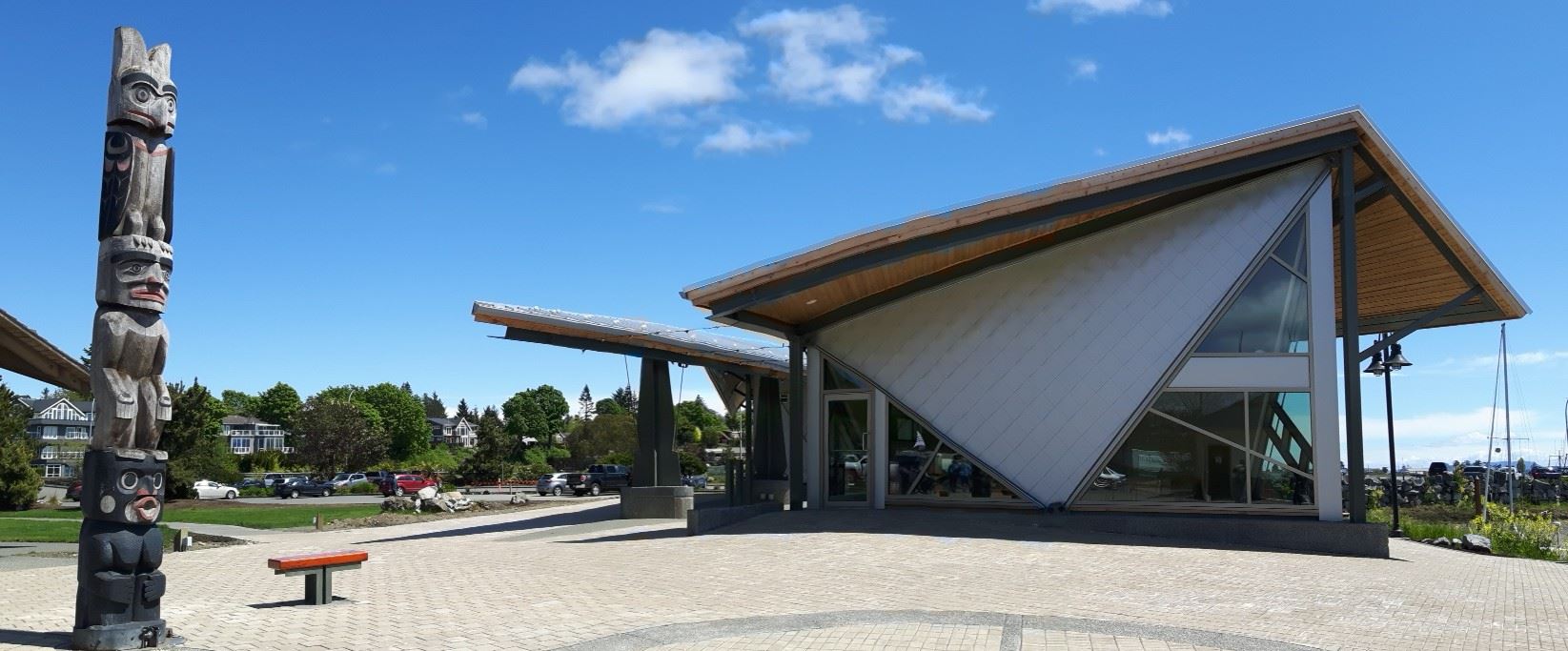
At the Comox Marina Park pavilion, standing seam handles waterfront exposure without the ongoing work that would strain a maintenance budget. Residences on the Sunshine Coast and the more remote sites we work on -- places where access is harder and contractors more expensive to call back -- see real savings over time.
Standing seam roofs need correct installation to work. Poor seaming leaves joints weak. Flashing mistakes at penetrations let water in through places that look fine on the surface. We have seen roofs fail not because the material failed but because shortcuts in installation did.
The panel profile matters too. Wider pans hold up better in wind. Better seaming equipment means tighter joints. These are not dramatic visual differences, but they show up in the first heavy storm. We also fabricate custom flashings in our own shop when standard pieces do not fit the geometry. That matters on complex rooflines where field-cut flashing can leave gaps.
Standing seam is not the only metal roofing approach we install. Curved panels, architectural sheet metal cladding, composite panels -- all have their moment. But for a steep residential slope facing the ocean, standing seam is hard to beat. Flashings around penetrations, drip edges, and ridge caps tie into the system cleanly.
On commercial work like the North Island Hospitals Project, we used multi-ply membrane roofs where standing seam would not fit the load and equipment demands. Each system solves specific problems. For a coastal home that needs to last and stay dry, standing seam solves the problem well.
If your roof is showing age or you are building new, give us a call at 250-336-8088. We provide free estimates with a detailed list of the work and the materials we would use, so you know exactly what you are getting before any work starts.
.svg)
.svg)
Our new website is live, bringing the full project portfolio, all eight service lines and our three service areas into one place.
A real estimate tells you exactly what you're paying for. Here's what separates an honest bid from a vague one.
The real tradeoffs between flat and pitched roofs for commercial buildings on Vancouver Island.
A practical checklist for Vancouver Island homeowners to prepare their roofs for heavy rain and wind before winter storms arrive.
Why exposed structural wood raises the stakes on weather protection and how to get moisture detailing right on Vancouver Island.
Why Nelson Roofing runs its own sheet metal fabrication shop, and what that means for fit, colour, and lead time on Vancouver Island projects.
How institutional scheduling works and why Campbell River schools plan roofing work around school holidays.
A guide to phased and after-hours roof replacement for BC businesses that cannot afford downtime.
Moss growth on shaded Island roofs damages shingles and drainage. Learn why it thrives on the coast and how to remove it safely.
Immediate steps to take when your roof leaks, what contractors need to know, and why quick patches often fail.
A practical guide to vetting roofing contractors: RCABC credentials, local references, written estimates, safety records, and who shows up to do the work.
A guide to TPO roofing for low-slope commercial and residential buildings on Vancouver Island, covering installation, maintenance, and real-world durability.
Standing seam metal roofing handles coastal weather better than most materials -- salt spray, wind, and heavy rain do not break it.
Island and water-access roofing requires planning materials, coordinating barge deliveries, and working within weather windows on the remote BC coast.
Institutional roofing on Vancouver Island requires infection control, strict phasing, and mechanical integration that standard commercial projects rarely face.
Nelson Roofing completed 776,700 sq ft of roofing across two major hospital builds on Vancouver Island, the largest contract in company history.
How Nelson Roofing delivered the cladding and custom sheet-metal package on two mass timber buildings holding 217 beds in Courtenay.
The VIU Shellfish Research Centre in Deep Bay won the 2011 Metalmag Architectural Award (Roofing Category) for its curved radius seam metal roof.
How Nelson Roofing manages multi-family roofing projects on Vancouver Island with noise control, resident safety, and marine-grade detailing.
Nelson Roofing brings the same exacting standards to Powell River and the Sunshine Coast as we do on Vancouver Island -- logistics are different, but quality never wavers.
Why HVAC and roofing decisions must be coordinated from the design phase, not bolted together after the fact.
Compare metal, shingle, and low-slope roofing options for Vancouver Island coastal homes dealing with rain, wind, and salt exposure.
What commercial property owners should know about roofing systems, membranes, and phased installations around tenant operations on Vancouver Island.
A practical fall checklist for Vancouver Island homeowners to prepare coastal roofs for winter weather.
A plain walkthrough of a commercial or residential roof replacement, from inspection and tear-off to final cleanup and warranty.
Nelson Roofing handles roofing, sheet metal fabrication, and HVAC across Vancouver Island - from student housing to hospitals and historic landmarks.
We were named Subcontractor of the Year at the 2026 VICA Awards for our cladding work on the North Island College student housing project.
The RCABC magazine Roofing BC profiled the company in its Summer 2014 issue, covering our change of ownership and four recent projects.
Canadian Roofing Contractor and Design profiled our work on the Deep Bay shellfish research field station in its January/February 2012 issue.
.svg)
.svg)
.svg)
.svg)

.svg)
.svg)