
Date of Publication
June 13, 2026
Category
Resources
Repost This Article
.svg)
.svg)
.svg)
.svg)
The Campbell River School Board scheduled their roof replacement for July and August. The building had been tracked for months. The timing was deliberate: work during the school year means noise, tarps, and disrupted operations while students and staff are in the building. Summer removes that problem.
School boards across BC coordinate roof replacements the same way. Once you understand the constraints, the logic is straightforward.
A school is never fully shut down. Even when students leave for summer, maintenance staff are in the building. The roof over the gym may be fine, but the administration wing or library needs work. Running a roofing crew in November over occupied classrooms means managing water ingress while kids are trying to learn, rescheduling classes, and dealing with noise that becomes both a safety and a teaching problem. None of that is acceptable to a school board, and none of it has to happen if the project is planned right.
Summer on the BC coast gives facility managers a reliable stretch of dry weather. Winter is ruled out for most projects -- heavy rain, changing roof conditions week to week, and the risk of interior water damage make it impractical. Spring and fall are transition months; you cannot count on them for a project that needs to be watertight before school starts again. Summer is when the work can be done right and closed up before September.
The planning starts months earlier. Facility managers inspect roofs in late winter or early spring, identify what needs replacing or repairing, and request quotes from contractors. That gives schools and public buildings time to get funding approvals, work through procurement, and slot the project into the summer window when both contractor availability and weather are on your side.
A school roof is not a residential re-roof. The footprints are larger. The structural demands are stricter -- schools are built to codes that account for snow load, wind, and years of maintenance traffic across the roof. When you are replacing the roof on a school building, you are also planning how crews will access the roof, where they will stage materials, and how the job will be managed without disturbing anything below.
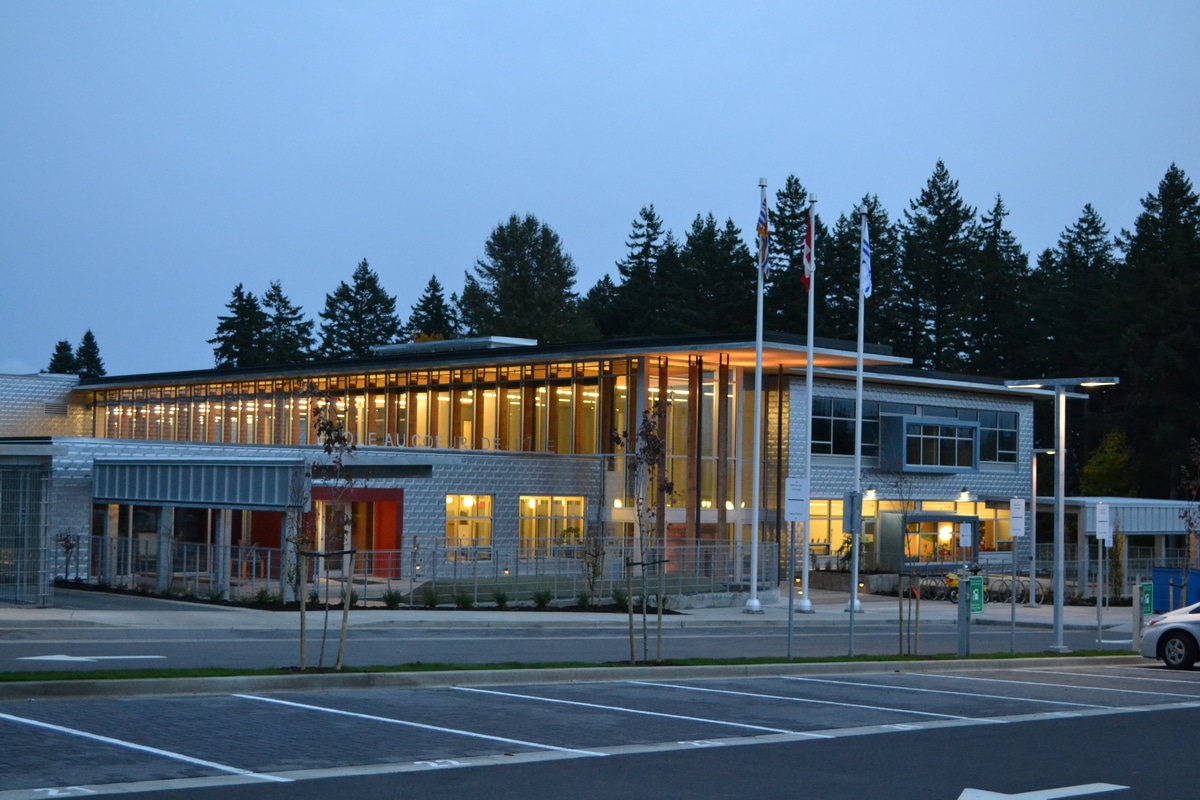
We have worked on schools and institutional buildings across Vancouver Island and the Sunshine Coast. L'ecole Au-coeur-de-l'ile, the francophone school in Comox, involved 48,438 sq ft of roofing and architectural cladding, with custom flashings and parapet caps fabricated in our own shop. The K'omoks First Nation's I-Hos Gallery in Comox is another example -- a landmark building where the roofing and sheet metal had to complement the carved facade without overshadowing it. Each building has a specific footprint, a specific need, and a schedule that has to work around operations.
Schools that plan roof work in advance -- identifying wear, budgeting, and setting the timeline before a leak forces the issue -- get better results than those that react to emergencies. The Campbell River School Board took the right approach. They saw the problem, tracked it, and scheduled the work for when it made sense operationally.
Emergency roof work mid-school-year costs more. You are competing for contractor availability, rushing material orders, and managing disruption to classes. Plan in advance, pick the summer window, and the work gets done properly rather than patched under pressure.
If you manage a school, community centre, or health facility in Campbell River, the Comox Valley, or the Sunshine Coast, start your roof assessment in late winter or early spring. Check for leaks, note the age of the membrane, and get a detailed estimate before the summer queue fills up.
We provide free estimates that include a full list of the work to be done and the materials used. Nelson Roofing and Sheet Metal has been doing this work since 1980 and knows how to fit institutional projects around your operational calendar. Call us at 250-336-8088 to schedule an inspection before the summer window closes.
.svg)
.svg)
A real estimate tells you exactly what you're paying for. Here's what separates an honest bid from a vague one.
The real tradeoffs between flat and pitched roofs for commercial buildings on Vancouver Island.
A practical checklist for Vancouver Island homeowners to prepare their roofs for heavy rain and wind before winter storms arrive.
Why exposed structural wood raises the stakes on weather protection and how to get moisture detailing right on Vancouver Island.
Why Nelson Roofing runs its own sheet metal fabrication shop, and what that means for fit, colour, and lead time on Vancouver Island projects.
How institutional scheduling works and why Campbell River schools plan roofing work around school holidays.
A guide to phased and after-hours roof replacement for BC businesses that cannot afford downtime.
Moss growth on shaded Island roofs damages shingles and drainage. Learn why it thrives on the coast and how to remove it safely.
Immediate steps to take when your roof leaks, what contractors need to know, and why quick patches often fail.
A practical guide to vetting roofing contractors: RCABC credentials, local references, written estimates, safety records, and who shows up to do the work.
A guide to TPO roofing for low-slope commercial and residential buildings on Vancouver Island, covering installation, maintenance, and real-world durability.
Standing seam metal roofing handles coastal weather better than most materials -- salt spray, wind, and heavy rain do not break it.
Island and water-access roofing requires planning materials, coordinating barge deliveries, and working within weather windows on the remote BC coast.
Institutional roofing on Vancouver Island requires infection control, strict phasing, and mechanical integration that standard commercial projects rarely face.
How Nelson Roofing manages multi-family roofing projects on Vancouver Island with noise control, resident safety, and marine-grade detailing.
Nelson Roofing brings the same exacting standards to Powell River and the Sunshine Coast as we do on Vancouver Island -- logistics are different, but quality never wavers.
Why HVAC and roofing decisions must be coordinated from the design phase, not bolted together after the fact.
Compare metal, shingle, and low-slope roofing options for Vancouver Island coastal homes dealing with rain, wind, and salt exposure.
A practical fall checklist for Vancouver Island homeowners to prepare coastal roofs for winter weather.
A plain walkthrough of a commercial or residential roof replacement, from inspection and tear-off to final cleanup and warranty.
The RCABC magazine Roofing BC profiled the company in its Summer 2014 issue, covering our change of ownership and four recent projects.
Canadian Roofing Contractor and Design profiled our work on the Deep Bay shellfish research field station in its January/February 2012 issue.
.svg)
.svg)
.svg)
.svg)

.svg)
.svg)