
Date of Publication
June 13, 2026
Category
Resources
Repost This Article
.svg)
.svg)
.svg)
.svg)
Walk onto most roofing jobs and you will see flashings that came from a supplier across the border. Stock profiles, stock colours, and they get the job done. Our sheet metal fabrication on Vancouver Island has worked differently since we started in 1980 - we bend the pieces ourselves, in our own shop. It costs money to run that shop, to keep the equipment tuned, to hire people who know how to work metal. We do it because it keeps us accountable to the details in a way that ordering from a catalog does not.
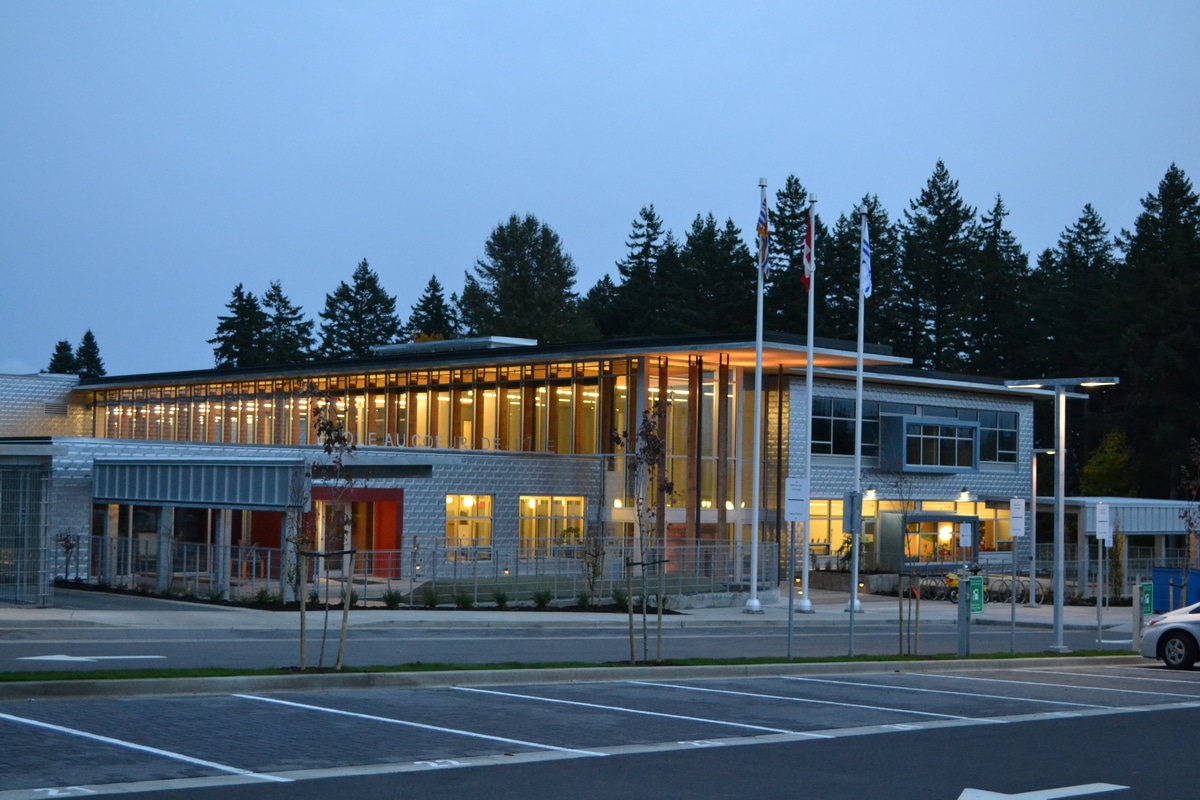
A standard flashing is designed to fit standard conditions. Parapet caps come in common heights. Trim profiles sit in common wall thicknesses. Real buildings are not always common. When we finished the roofing at L'ecole Au-coeur-de-l'ile in Comox - a mass-timber francophone school - the parapets had geometry that stock flashings would not touch. We bent custom caps in our shop to match the exact profile, the exact angle, the exact width the architect specified.
That fit matters. A flashing that is a half-inch too tall or sits proud of the wall does not just look rough. It can trap moisture, create shadows for moss to grow, or let wind get underneath it. When we make the flashing ourselves, we measure twice and we own the result.
You pick a metal cladding colour for your building. Then the contractor orders flashings to match, and what arrives is close but not the same. Paint oxidizes differently. Batch variations exist. We have seen buildings where the parapets, soffits, and trim are three slightly different shades because they came from three different suppliers.
When we fabricate in our shop, we are working from the same coil of metal. The colour is consistent across every piece. We have bent parapet caps, trim, soffit returns, and wall flashings all from the same stock, and they all go up the same shade. It sounds simple, but it is one of those details that separates a building that looks deliberate from one that looks like it came together by accident.
Commercial projects have schedules. When the roofing crew is ready to flash the penthouse, you cannot wait weeks for a special order to land at a supplier. Having our own shop means we can turn around custom pieces in days. For the VIU Shellfish Research Centre in Deep Bay - a 13,200 sq ft curved metal roof where we bent radius seam panels on site over structural timber ribs - we needed exactly that kind of flexibility. The site was remote. Waiting on outside suppliers was not an option.
On remote sites, and plenty of North Island work is remote, that flexibility saves money, saves time, and keeps the job moving.
Our shop bends flashings, parapet caps, wall trim, soffit returns, and architectural cladding panels. We work in copper, aluminum, galvanized steel, and painted metal. We handle everything from simple bends on residential work to complex multi-seam panels for mass-timber buildings.
When an architect specifies something we have not bent before, we sit down with the detail drawings and figure it out. That is part of the work. We have curved seam panels, fabricated bracket systems for mechanical enclosures, and bent custom trim for buildings with non-standard wall framing. The skill is in reading the drawing, understanding what the building needs, and making sure the metal fits.
In-house fabrication means we are not passing off responsibility to a supplier. If a flashing leaks two years from now, we made it. If a cap does not sit right, we built it. That focus changes how we approach the work. We will call the architect if we think a detail needs adjustment. We will make a test piece and fit it on site if the measurements are tight.
That is not available when you are ordering from a catalog. It is available when the shop is next door to the office.
If you are planning a roof or cladding project on Vancouver Island and want the metal work done right, call us at 250-336-8088. Free estimates include a detailed list of the fabrication work and materials your project requires.
.svg)
.svg)
A real estimate tells you exactly what you're paying for. Here's what separates an honest bid from a vague one.
The real tradeoffs between flat and pitched roofs for commercial buildings on Vancouver Island.
A practical checklist for Vancouver Island homeowners to prepare their roofs for heavy rain and wind before winter storms arrive.
Why exposed structural wood raises the stakes on weather protection and how to get moisture detailing right on Vancouver Island.
Why Nelson Roofing runs its own sheet metal fabrication shop, and what that means for fit, colour, and lead time on Vancouver Island projects.
How institutional scheduling works and why Campbell River schools plan roofing work around school holidays.
A guide to phased and after-hours roof replacement for BC businesses that cannot afford downtime.
Moss growth on shaded Island roofs damages shingles and drainage. Learn why it thrives on the coast and how to remove it safely.
Immediate steps to take when your roof leaks, what contractors need to know, and why quick patches often fail.
A practical guide to vetting roofing contractors: RCABC credentials, local references, written estimates, safety records, and who shows up to do the work.
A guide to TPO roofing for low-slope commercial and residential buildings on Vancouver Island, covering installation, maintenance, and real-world durability.
Standing seam metal roofing handles coastal weather better than most materials -- salt spray, wind, and heavy rain do not break it.
Island and water-access roofing requires planning materials, coordinating barge deliveries, and working within weather windows on the remote BC coast.
Institutional roofing on Vancouver Island requires infection control, strict phasing, and mechanical integration that standard commercial projects rarely face.
How Nelson Roofing manages multi-family roofing projects on Vancouver Island with noise control, resident safety, and marine-grade detailing.
Nelson Roofing brings the same exacting standards to Powell River and the Sunshine Coast as we do on Vancouver Island -- logistics are different, but quality never wavers.
Why HVAC and roofing decisions must be coordinated from the design phase, not bolted together after the fact.
Compare metal, shingle, and low-slope roofing options for Vancouver Island coastal homes dealing with rain, wind, and salt exposure.
A practical fall checklist for Vancouver Island homeowners to prepare coastal roofs for winter weather.
A plain walkthrough of a commercial or residential roof replacement, from inspection and tear-off to final cleanup and warranty.
The RCABC magazine Roofing BC profiled the company in its Summer 2014 issue, covering our change of ownership and four recent projects.
Canadian Roofing Contractor and Design profiled our work on the Deep Bay shellfish research field station in its January/February 2012 issue.
.svg)
.svg)
.svg)
.svg)

.svg)
.svg)