
Date of Publication
June 13, 2026
Category
News
Repost This Article
.svg)
.svg)
.svg)
.svg)
The Comox Marina Park pavilion sits exposed to wind and salt spray year-round. We installed standing seam metal roofing on this waterfront structure as part of our work in the region, and metal roofing Comox projects like this one demand a different level of detailing than inland work. The coastal climate here, heavy winter rain, wind storms, and salt carried off the Strait, does not forgive shortcuts at the flashings or fasteners.
A standing seam roof performs differently in a marine environment than it does on an inland building. The metal itself has to resist corrosion. The flashings -- the corners, seams, and terminations where water could enter -- have to be detailed tightly. The base and fasteners have to work together without trapping moisture. Get any of those wrong and you are looking at rust stains and water intrusion well before the roof reaches its expected service life.
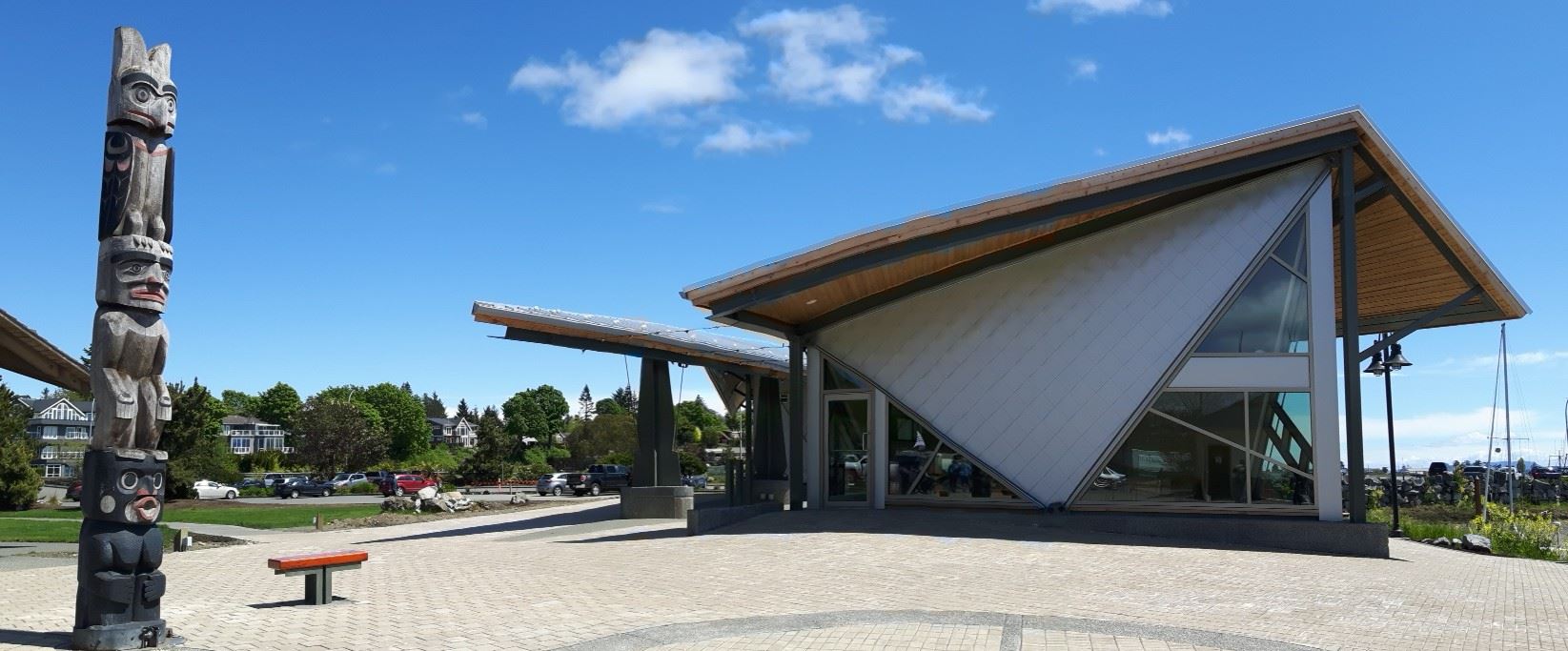
Standing seam panels run the full length of the roof, with seams that stand proud of the surface. Water drains off quickly. There are no exposed fasteners on the face of the roof -- that means no holes for salt water to work into. The vertical seam itself sheds water reliably, even when wind-driven rain is hitting the roof at an angle.
Metal also reflects rather than absorbs heat, which matters when people are using a pavilion through the warmer months. A properly installed standing seam roof lasts decades, and it has the appearance that fits a public waterfront facility. It looks substantial because it is.
The Comox Valley sits on the Strait of Georgia. Salt carries inland on the wind and deposits on any metal surface it can reach. Stainless steel or aluminum with the right finish stands up to it. Carbon steel rusts. The fasteners matter just as much as the panels. We use stainless fasteners to anchor the roof -- galvanized hardware corrodes and fails in a salt environment.
Flashings -- the custom metal pieces at edges, vents, and penetrations -- are where leaks start on a standing seam roof. Each flashing is designed to shed water away from the seam and the field of panels. On a waterfront structure, every flashing gets sealed properly. We fabricate these in our own shop, which lets us adapt the design to the specific building geometry and make sure every piece fits as it has to.
Wind loads matter too. Coastal storms bring sustained winds that can flex a roof. The seams have to be strong enough to hold through that movement without pulling apart or loosening fasteners. The substrate underneath has to support the system. A pavilion is often an open structure with less mass than a traditional building, which means the roof has to be engineered carefully to handle wind uplift.
Standing seam roofing is installed panel by panel, with each seam mechanically locked to the next. The result is continuous protection from the top of the roof down to the base. During installation, we protect the panels from damage and keep debris out of the seams. A clean, dry substrate prevents moisture from being trapped under the metal.
A standing seam roof on a waterfront pavilion benefits from periodic maintenance -- clearing gutters and drains, and occasional cleaning to remove salt residue. That is straightforward work that keeps the roof performing for its full service life. The investment in good materials and proper detailing at the start means you avoid expensive repairs later.
If you are planning a roofing project on Vancouver Island's coast, salt spray and wind are part of the design brief from the start. We have been working on commercial and residential roofs across the Comox Valley, Campbell River, and the Sunshine Coast since 1980, and we are RCABC-accredited. Call 250-336-8088 and we will put together a free estimate that details exactly how the roof will be built and what materials will be used.
.svg)
.svg)
Our new website is live, bringing the full project portfolio, all eight service lines and our three service areas into one place.
Nelson Roofing shares real work on two First Nations projects: I-Hos Gallery and Discovery Harbour Shopping Centre.
A guide to phased and after-hours roof replacement for BC businesses that cannot afford downtime.
Island and water-access roofing requires planning materials, coordinating barge deliveries, and working within weather windows on the remote BC coast.
How Nelson Roofing replaced 50,175 sq ft of membrane on a heritage 1930 arena while keeping games and events on schedule.
Nelson Roofing completed 776,700 sq ft of roofing across two major hospital builds on Vancouver Island, the largest contract in company history.
How Nelson Roofing delivered the cladding and custom sheet-metal package on two mass timber buildings holding 217 beds in Courtenay.
Real press coverage of Nelson Roofing's major island projects and what RCABC accreditation means for building owners.
The VIU Shellfish Research Centre in Deep Bay won the 2011 Metalmag Architectural Award (Roofing Category) for its curved radius seam metal roof.
How Nelson Roofing manages multi-family roofing projects on Vancouver Island with noise control, resident safety, and marine-grade detailing.
Campbell River dealerships like Strathcona Toyota need roofs that protect inventory while staying quiet during business hours.
How Nelson Roofing re-roofed Wembley Liquor Store in Parksville before and after hours while the store stayed open for customers.
Nelson Roofing brings the same exacting standards to Powell River and the Sunshine Coast as we do on Vancouver Island -- logistics are different, but quality never wavers.
Nelson Roofing installed standing seam metal roofing on the Comox Marina Park pavilion, engineered for coastal salt spray and wind exposure.
What commercial property owners should know about roofing systems, membranes, and phased installations around tenant operations on Vancouver Island.
Nelson Roofing handles roofing, sheet metal fabrication, and HVAC across Vancouver Island - from student housing to hospitals and historic landmarks.
We were named Subcontractor of the Year at the 2026 VICA Awards for our cladding work on the North Island College student housing project.
We were named 2025 RCABC Guarantee Corp Top Supporter for completing the most roofing squares on Vancouver Island last year.
Nelson Roofing marked 45 years in 2025, from Russ and Sharon Nelson's first crews in 1980 to three branches on the coast today.
The RCABC magazine Roofing BC profiled the company in its Summer 2014 issue, covering our change of ownership and four recent projects.
Canadian Roofing Contractor and Design profiled our work on the Deep Bay shellfish research field station in its January/February 2012 issue.
.svg)
.svg)
.svg)
.svg)

.svg)
.svg)