
Date of Publication
June 13, 2026
Category
Resources
Repost This Article
.svg)
.svg)
.svg)
.svg)
We put a TPO roof on Crown Isle Building H in Courtenay, and it has held up exactly as it should in our coastal climate. That is the job of any roofing system here on Vancouver Island: handle persistent rain and coastal exposure without demanding constant attention. TPO roofing on Vancouver Island low-slope buildings is something we install regularly, and for good reason. TPO (thermoplastic polyolefin) is a single-ply membrane, and for flat and low-slope commercial and residential buildings, it is one of the most sensible systems available.
TPO is a thermoplastic membrane, not to be confused with EPDM, which is a rubber-based product. The material runs homogeneous throughout -- the same composition top to bottom. That matters because if a seam fails on some multi-ply systems, you are looking at exposed layers underneath. With TPO, one continuous layer does the work, and when installed correctly, it is reliable.
A low-slope roof is not truly flat. Building code defines low-slope as anything under a 3:12 pitch -- three inches of rise for every twelve inches of run. Traditional asphalt shingles do not work there. Water moves too slowly and pools. You need a membrane system. TPO is one of three common options alongside EPDM and PVC. We use TPO often because it reflects UV, the material is lighter than some alternatives, and the heat-welded seams produce a consistently strong bond.
The seams in a TPO roof are welded, not glued. A technician runs a heat welder along the overlap where two sheets meet, and the material fuses together. In our wet climate, adhesive can fail over time as moisture works into gaps. A properly executed weld bonds stronger than the surrounding membrane.
Flashings are where most membrane roof leaks start. The metal trim around penetrations, roof edges, and mechanical equipment has to be tight and durable. We fabricate custom flashings in our own shop to match the specifics of each building. At Crown Isle Building H we detailed the TPO with standing-seam metal fascia and trim. The membrane tucks and seals under the metal, keeping water out at every transition.
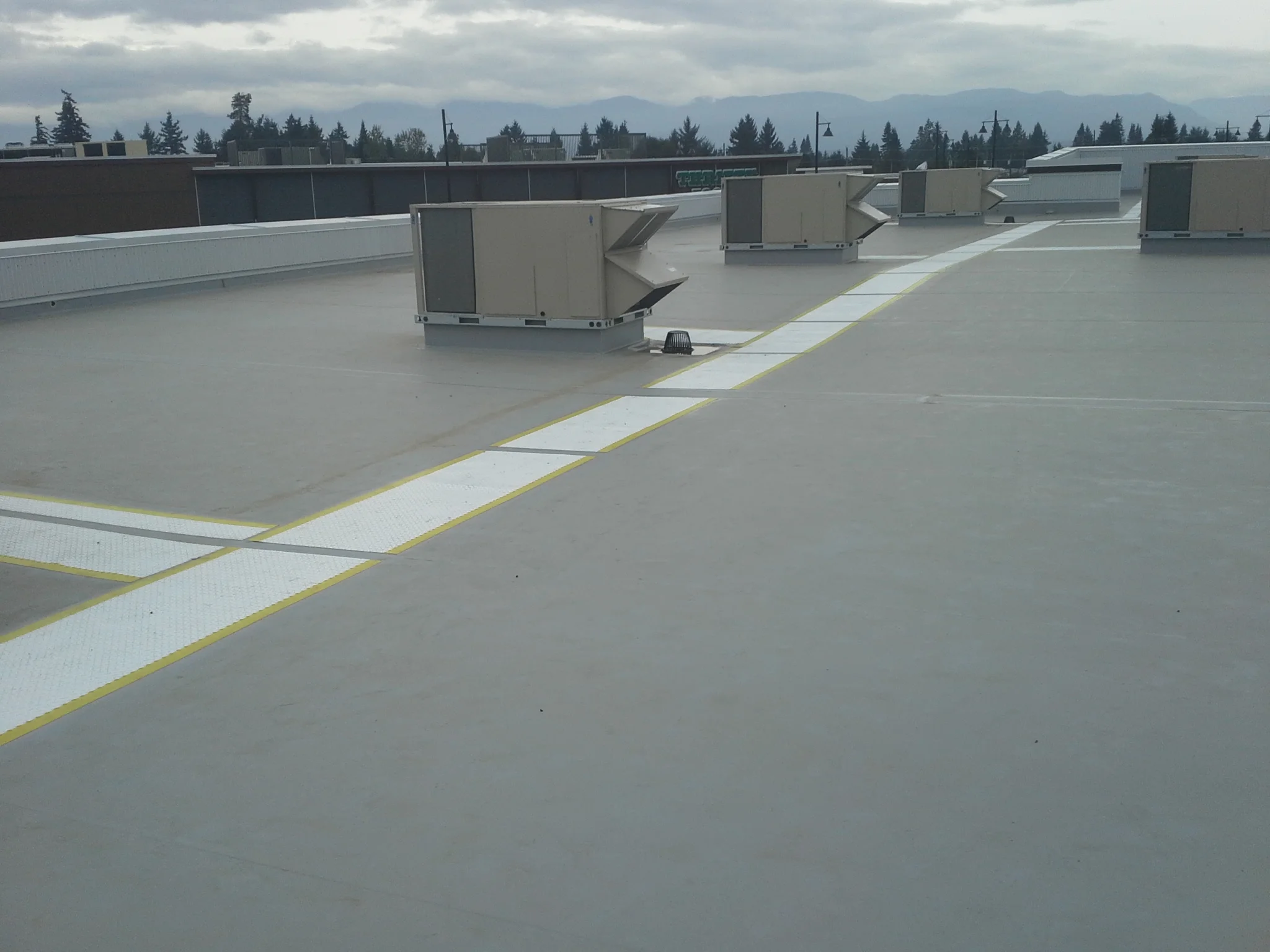
Slope and drainage matter just as much as the membrane itself. Low-slope roofs collect water in low spots. Crickets -- peaked sections that divert water toward drains -- and correct drain placement have to be worked out before the membrane goes down. Poor drainage design will defeat even a good installation.
TPO roofs do not demand much. Twice a year, in spring and fall, walk the roof and clear any debris. On Vancouver Island, moss and algae grow readily on shaded or north-facing sections. A soft brush and a gentle cleaning keep them from taking hold and trapping moisture. Keep drains and gutters clear.
Regular inspections catch small problems before they become large ones. Punctures from foot traffic or debris are straightforward to patch. Seams hold if they were welded properly at the start. If a facility has staff regularly walking the roof for mechanical maintenance, TPO handles that traffic well and is easier to repair in place than systems requiring full-section replacement.
It is a strong choice for low-slope commercial roofs, residential flat-roof additions, and industrial buildings. The material cost sits in a moderate range, and the installation process is efficient enough that disruption to an occupied building is limited.
PVC and EPDM both have applications where they perform better than TPO. No single membrane is right for every situation. We will tell you if a different system makes more sense for your building.
If your low-slope roof is aging or you are planning a new build with a flat section, call us at 250-336-8088 to arrange a site visit. Estimates are free and include a detailed list of the work to be done and the materials used, so you know exactly what you are getting before you commit.
.svg)
.svg)
A real estimate tells you exactly what you're paying for. Here's what separates an honest bid from a vague one.
The real tradeoffs between flat and pitched roofs for commercial buildings on Vancouver Island.
A practical checklist for Vancouver Island homeowners to prepare their roofs for heavy rain and wind before winter storms arrive.
Why exposed structural wood raises the stakes on weather protection and how to get moisture detailing right on Vancouver Island.
Why Nelson Roofing runs its own sheet metal fabrication shop, and what that means for fit, colour, and lead time on Vancouver Island projects.
How institutional scheduling works and why Campbell River schools plan roofing work around school holidays.
A guide to phased and after-hours roof replacement for BC businesses that cannot afford downtime.
Moss growth on shaded Island roofs damages shingles and drainage. Learn why it thrives on the coast and how to remove it safely.
Immediate steps to take when your roof leaks, what contractors need to know, and why quick patches often fail.
A practical guide to vetting roofing contractors: RCABC credentials, local references, written estimates, safety records, and who shows up to do the work.
A guide to TPO roofing for low-slope commercial and residential buildings on Vancouver Island, covering installation, maintenance, and real-world durability.
Standing seam metal roofing handles coastal weather better than most materials -- salt spray, wind, and heavy rain do not break it.
Island and water-access roofing requires planning materials, coordinating barge deliveries, and working within weather windows on the remote BC coast.
Institutional roofing on Vancouver Island requires infection control, strict phasing, and mechanical integration that standard commercial projects rarely face.
How Nelson Roofing manages multi-family roofing projects on Vancouver Island with noise control, resident safety, and marine-grade detailing.
Nelson Roofing brings the same exacting standards to Powell River and the Sunshine Coast as we do on Vancouver Island -- logistics are different, but quality never wavers.
Why HVAC and roofing decisions must be coordinated from the design phase, not bolted together after the fact.
Compare metal, shingle, and low-slope roofing options for Vancouver Island coastal homes dealing with rain, wind, and salt exposure.
A practical fall checklist for Vancouver Island homeowners to prepare coastal roofs for winter weather.
A plain walkthrough of a commercial or residential roof replacement, from inspection and tear-off to final cleanup and warranty.
The RCABC magazine Roofing BC profiled the company in its Summer 2014 issue, covering our change of ownership and four recent projects.
Canadian Roofing Contractor and Design profiled our work on the Deep Bay shellfish research field station in its January/February 2012 issue.
.svg)
.svg)
.svg)
.svg)

.svg)
.svg)