
Date of Publication
June 13, 2026
Category
Resources
Repost This Article
.svg)
.svg)
.svg)
.svg)
Walk through any commercial district on Vancouver Island and you see the split. Modern office complexes, shopping centres, and industrial buildings sit under flat roofs. Older structures, churches, and heritage buildings still wear pitched roofs. Neither is wrong, but they are not interchangeable. If you are planning a flat roof replacement BC project or assessing an existing pitched system, understanding the real differences saves you time and money before you call anyone.
At Nelson Roofing, we have built roofs in both styles across the Island and the Sunshine Coast. We re-roofed the 50,175-square-foot Queens Park Arena in New Westminster and handled the roofing and sheet metal at Discovery Harbour Shopping Centre in Campbell River. We know what each system costs to install and to keep.
Flat roofs dominate commercial real estate because they are efficient. HVAC units, mechanical penthouses, and future expansion space all live on top of the building. That is hard to beat operationally.
The tradeoff is drainage. Water does not run off a flat roof the way it does on a pitched one. You need membrane systems -- multi-ply installations or single-ply TPO, like the system we installed at Crown Isle Building H in Courtenay -- engineered to shed water reliably toward internal drains, scuppers, or perimeter gutters. Get the slope wrong, miss a seal, or neglect maintenance, and water pools where it should not.
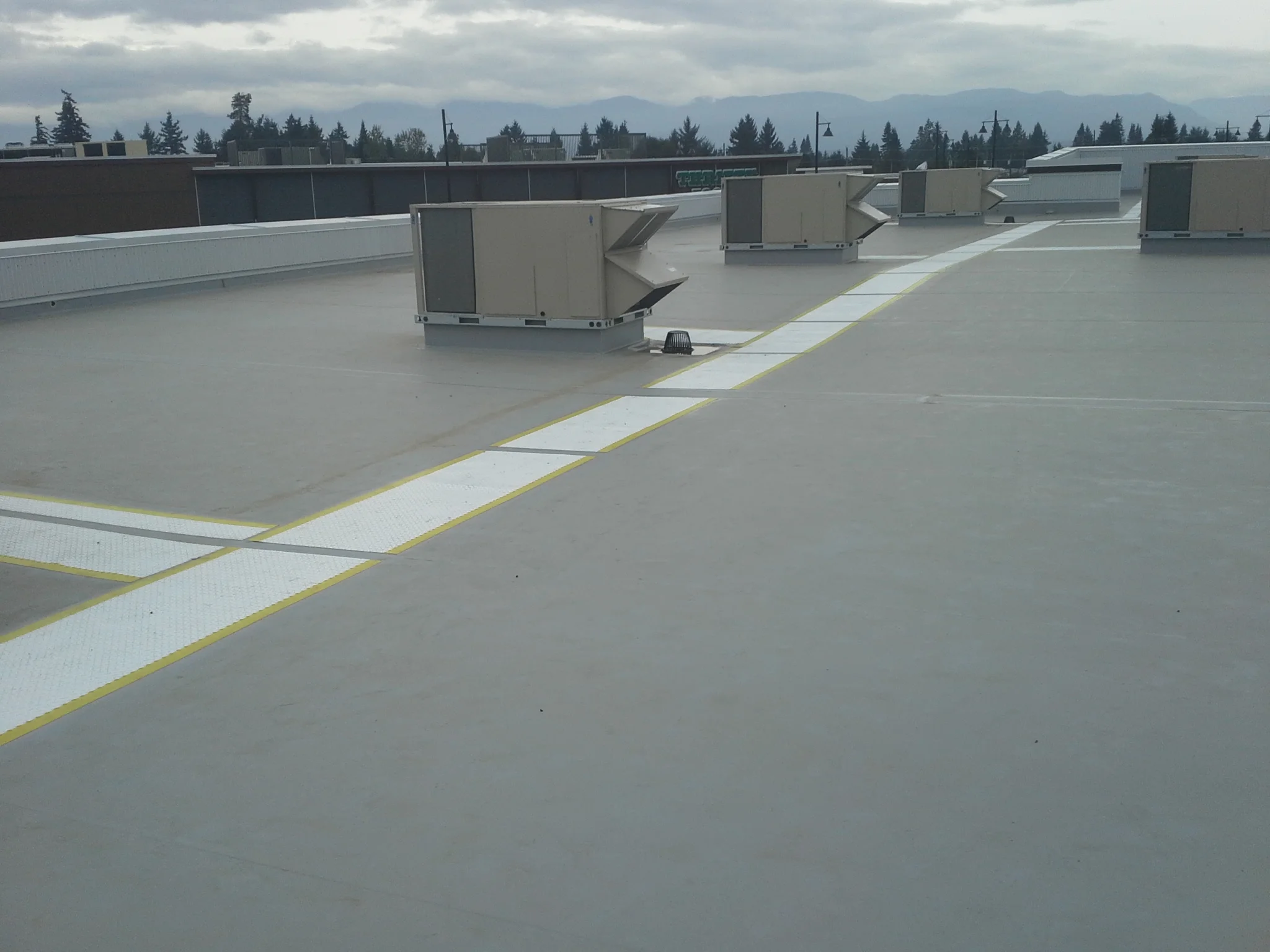
Flat roofs also demand regular inspection. Membrane roofs expand and contract with temperature swings. Flashings around mechanical penetrations, roof drains, and parapet edges are where problems start. We built the North Island Hospitals Project across Campbell River and Comox -- 776,700 square feet combined -- with strict protocols around membrane integrity because hospital operations cannot tolerate leaks. That same discipline applies to any flat roof on the wet coast.
Heavy winters on the Island mean sustained water pressure, wind-driven moisture, and ice dam potential at the edges. Your membrane system has to be installed right and inspected before winter arrives.
A pitched roof moves water the moment it lands. Gravity does the work. That is why heritage buildings, churches, and residential designs have used pitch for centuries. On the commercial side it is less common now, but when you choose it or inherit it, the benefits are real.
Drainage is passive and forgiving. Moss will still grow on shaded slopes in our climate, and gutters still need clearing, but the roof itself does not pool water. That is one category of problem you avoid entirely.
The limits are also real. You lose usable square footage for anything that would sit on a flat roof. Mechanical equipment that nests in a penthouse on a flat-roofed building needs to fit elsewhere. And pitched roofs have their own weak points: valleys where water concentrates, ridge lines that need flashing, and eaves that catch wind-driven rain in coastal storms.
Flat roofs need more active maintenance. Membrane inspections, drain cleaning, flashings you monitor on a schedule. Budget for that from day one. Pitched roofs need different work -- gutter maintenance and targeted panel or shingle replacement -- but less intensive overall membrane inspection.
Both need attention before winter and after storms. Both need prompt repair when damage appears. The difference is the rhythm. Flat roofs reward preventive effort. Pitched roofs need less constant oversight but more targeted repair when wind, snow load, or age takes its toll.
New construction usually favours flat roofs. Architects and developers want mechanical flexibility and usable square footage on top. Heritage or existing pitched roofs are worth keeping if your structure and budget allow, especially when drainage has been working well. Retrofitting from one type to the other is a major undertaking and rarely makes financial sense.
Your building's footprint, your location, your mechanical loads, and your maintenance capacity all determine which system you can keep healthy. We have worked on both styles across Vancouver Island and the Sunshine Coast, from small commercial spaces to the North Island College Student Housing Commons -- 217 beds across two four-storey mass-timber buildings in Courtenay. We can walk through what your building actually needs and what it will cost to maintain.
Call us at 250-336-8088. Estimates are free and include a detailed list of the work and the materials used.
.svg)
.svg)
A real estimate tells you exactly what you're paying for. Here's what separates an honest bid from a vague one.
The real tradeoffs between flat and pitched roofs for commercial buildings on Vancouver Island.
A practical checklist for Vancouver Island homeowners to prepare their roofs for heavy rain and wind before winter storms arrive.
Why exposed structural wood raises the stakes on weather protection and how to get moisture detailing right on Vancouver Island.
Why Nelson Roofing runs its own sheet metal fabrication shop, and what that means for fit, colour, and lead time on Vancouver Island projects.
How institutional scheduling works and why Campbell River schools plan roofing work around school holidays.
A guide to phased and after-hours roof replacement for BC businesses that cannot afford downtime.
Moss growth on shaded Island roofs damages shingles and drainage. Learn why it thrives on the coast and how to remove it safely.
Immediate steps to take when your roof leaks, what contractors need to know, and why quick patches often fail.
A practical guide to vetting roofing contractors: RCABC credentials, local references, written estimates, safety records, and who shows up to do the work.
A guide to TPO roofing for low-slope commercial and residential buildings on Vancouver Island, covering installation, maintenance, and real-world durability.
Standing seam metal roofing handles coastal weather better than most materials -- salt spray, wind, and heavy rain do not break it.
Island and water-access roofing requires planning materials, coordinating barge deliveries, and working within weather windows on the remote BC coast.
Institutional roofing on Vancouver Island requires infection control, strict phasing, and mechanical integration that standard commercial projects rarely face.
How Nelson Roofing manages multi-family roofing projects on Vancouver Island with noise control, resident safety, and marine-grade detailing.
Nelson Roofing brings the same exacting standards to Powell River and the Sunshine Coast as we do on Vancouver Island -- logistics are different, but quality never wavers.
Why HVAC and roofing decisions must be coordinated from the design phase, not bolted together after the fact.
Compare metal, shingle, and low-slope roofing options for Vancouver Island coastal homes dealing with rain, wind, and salt exposure.
A practical fall checklist for Vancouver Island homeowners to prepare coastal roofs for winter weather.
A plain walkthrough of a commercial or residential roof replacement, from inspection and tear-off to final cleanup and warranty.
The RCABC magazine Roofing BC profiled the company in its Summer 2014 issue, covering our change of ownership and four recent projects.
Canadian Roofing Contractor and Design profiled our work on the Deep Bay shellfish research field station in its January/February 2012 issue.
.svg)
.svg)
.svg)
.svg)

.svg)
.svg)